SpaceX Paid $10 Billion for a Call Option on Cursor. That's a Great Deal.

Yesterday SpaceX announced a partnership with Cursor, the AI coding tool. The headline number was $60 billion. That is not the interesting number.
The interesting number is $10 billion: the amount SpaceX pays regardless of what happens next. Cursor gave SpaceX the right to acquire the company later this year for $60 billion, or alternatively just pay $10 billion for the collaboration and the compute. That "or" is the entire deal. SpaceX is not buying Cursor. SpaceX is buying a call option on Cursor, and the premium is $10 billion.
Within hours, quant Twitter had the term sheet apart. The cleanest read came from @fluorane, a Jane Street alum, who pointed out what the headlines were getting wrong:
The $60 billion is not the strike. The $60 billion is the total exercise cost. SpaceX already pays $10 billion for the collaboration regardless. The incremental cost to acquire is $60B minus the $10B already committed: a $50 billion strike price. That reframes the entire deal.
The option, properly stated
Strip it down to the financial instrument:
The option is European-style (single exercise date at expiry), roughly at-the-money, with 8 months to run. That is enough to price it.
But what is the premium, really?
$10 billion in cash is the floor. The deal also gives Cursor access to SpaceX's Colossus supercomputer, which the announcement describes as a "million H100 equivalent." That compute has a dollar value.
H100 cloud rental rates have been volatile: per the SemiAnalysis GPU Pricing Index, 1-year contract rates fell from ~$3.10/hr in early 2023 to a low of ~$1.70/hr in late 2025, then rebounded to ~$2.30/hr by March 2026 as training cluster buildouts intensified.
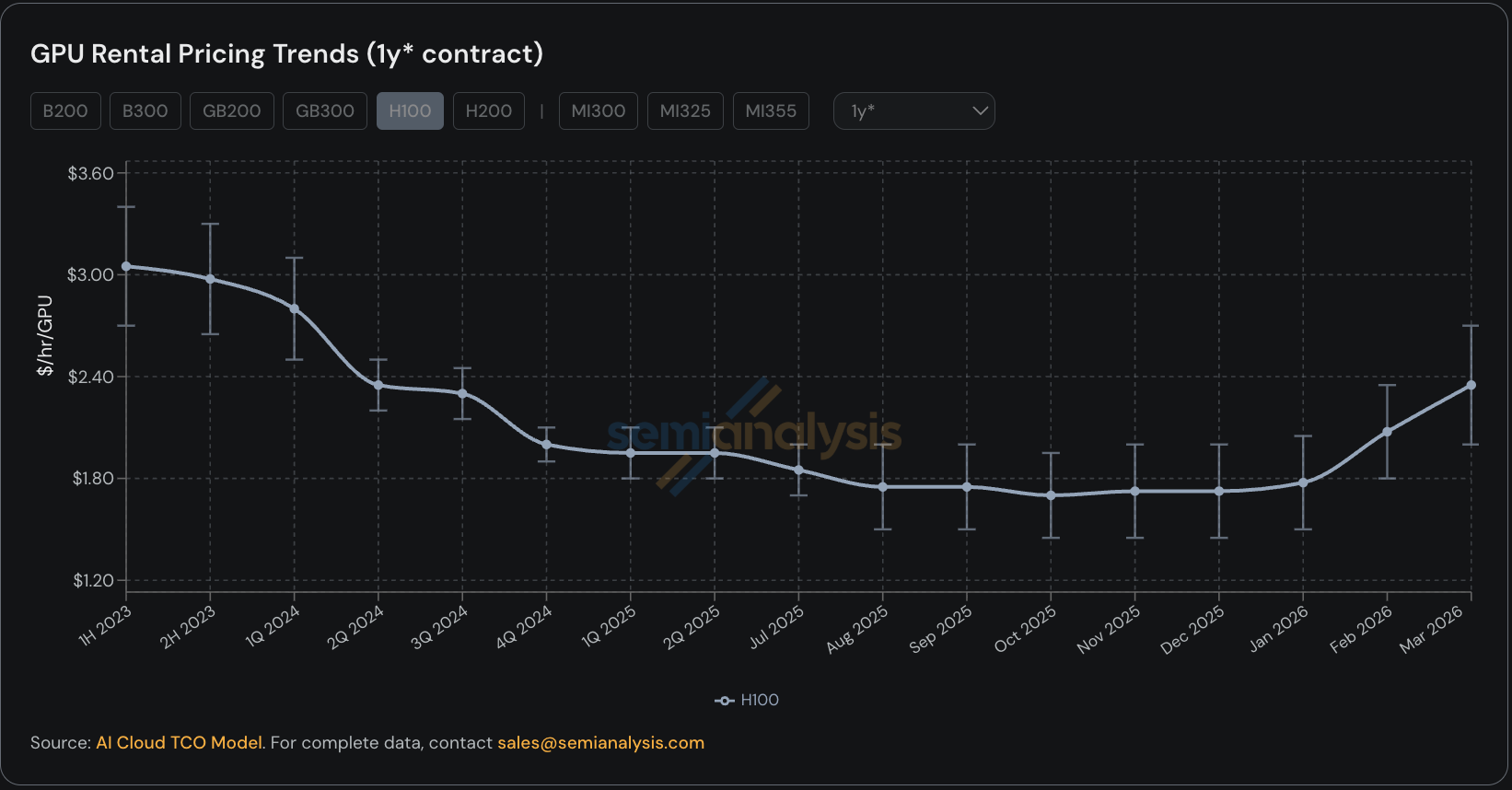
At the current ~$2.00-2.30/hr range, a million-GPU-equivalent cluster running for the 8-month deal window is worth on the order of $5-10 billion in equivalent compute. The GPU contribution is not a rounding error on the $10B cash. It is a second premium leg of comparable size.
That gives two framings:
| Framing | Premium | C/S | Implied vol |
|---|---|---|---|
| Cash only | $10B | 20% | ~58% |
| Cash + GPU compute | ~$15B | ~30% | ~91% |
The cash-only framing gives 58% implied vol. Load in the full compute contribution and it jumps to 91%.
The GPU premium also has a reflexive property: the compute improves the underlying. Cursor gets GPU access to train better models, those models make the product better, a better product increases Cursor's valuation, and a higher valuation makes the option more likely to finish in-the-money. The premium is not dead weight. It is a feedback loop that Black-Scholes does not capture.
There is one more variable in the premium: what SpaceX pays with. If SpaceX exercises with its own stock rather than cash, the value Cursor shareholders receive depends on whether that stock is liquid. SpaceX confidentially filed for IPO in early April 2026, so by exercise time it could be public, but lock-up periods and IPO timing introduce uncertainty that shifts the effective strike.
Price the deal yourself
The calculator below inverts the Black-Scholes model: given the deal's known inputs (premium, strike, tenor), it solves for the implied volatility. Adjust the assumptions and watch how the vol moves.
How does this compare to things you can actually trade?
This is where it gets interesting. @fluorane made the comparison to NVIDIA:
NVDA is trading around $200. The December 18, 2026 $200 call (ATM, same-ish tenor) is at ~$30, or 15% of spot. That implies about 42% vol.
But we do not have to stop at one comparison. We pulled the live Deribit vol surface as of April 22, 2026 01:04 UTC. The December 25, 2026 expiry is 247 days out, or 0.68 years, nearly identical to the Cursor deal's ~0.66-year tenor. Here is every asset class we can price at the same maturity:
| Asset | Spot | Tenor | ATM IV | C/S (ATM) | Source |
|---|---|---|---|---|---|
| NVDA | ~$200 | 0.66y | ~42% | ~15% | @fluorane / listed options |
| BTC | $77,786 | 0.68y | 44.5% | ~16% | Deribit 25DEC26 |
| Cursor (cash only) | ~$50B | 0.66y | ~58% | 20% | Deal terms / BS inversion |
| BE | $221 | 0.66y | 101% | ~34% | Polygon / listed options |
| Cursor (cash + GPUs) | ~$50B | 0.66y | ~91% | ~30% | Deal terms / BS inversion |
What these numbers actually mean in dollar terms
Implied volatility is a forecast. It tells you the range of outcomes the market is pricing in. At 58% IV over 0.66 years, the market expects Cursor's valuation to swing by roughly of its current value within one standard deviation (68% probability). At 42% IV, NVDA's expected swing is 34%.
Select an asset below to see what the implied vol actually means in dollar terms:
SpaceX paid a premium that implies less uncertainty about Cursor than the listed options market prices into Bloom Energy, a public company at similar market cap. For the largest-revenue AI coding tool on the planet, inside an eight-month window that includes a SpaceX IPO, that does not look expensive. @fluorane's conclusion was direct: a 20% premium on an ATM end-of-year call is a good price if you believe the underlying should carry higher vol than NVDA, and a private AI company growing at Cursor's pace almost certainly should.
This is not a new structure
Every few years, a deal lands that makes the front page as a headline number and the back page as a structured option. The SpaceX-Cursor deal is the latest. It is not the first.
What the prediction market says
Manifold Markets is currently pricing the probability that SpaceX/xAI acquires Cursor in 2026 at 78%. The Black-Scholes risk-neutral probability of exercise is 43%. That is a 35-point gap, and it is the most interesting number in this entire analysis.
Three factors bridge the gap:
1. The equity risk premium. Real-world probabilities for positive outcomes are always higher than risk-neutral probabilities. This is textbook. If you applied the same gap to NVDA, you would see a similar delta between the BS-implied exercise probability and what a prediction market would say about "will NVDA be above $200 in December?"
2. Strategic exercise above breakeven. BS says SpaceX exercises only if Cursor's valuation exceeds $50B at expiry. But SpaceX might exercise even if Cursor is worth $45B, because the strategic value of vertical integration (owning the best coding AI before an IPO) exceeds the $5B shortfall. The effective strike is lower than $50B in strategic terms, which pushes the real-world exercise probability higher than the financial probability.
3. The reflexivity we just described. The Colossus compute makes Cursor more valuable, which makes exercise more likely, which makes the option worth more than a static BS model suggests. The prediction market prices this in. The BS model does not.
@fluorane also noted the sensitivity of the strike to the perception of the deal. At a $30-40B strike, the option is deep in-the-money and exercise is near-certain. At $50B (ATM), exercise is conditional. The deal was structured right at the boundary where the outcome is genuinely uncertain, which is exactly where options have the most value.
Cursor on Hypercall?
The SpaceX-Cursor deal is a call option that only two parties can trade. SpaceX and Cursor negotiated it bilaterally, and nobody else can buy, sell, or hedge it. That is a $10 billion option with zero liquidity. But the infrastructure to change that already exists.
Ventuals is already trading perps on SpaceX, OpenAI, and Anthropic on Hyperliquid via HIP-3, 24/7, with up to 20x leverage. That is delta-one exposure to private company valuations, on-chain, right now. If you think Cursor is worth more than $50B, you can already express that view through a Ventuals perp.
But a perp is not an option. A perp gives you linear exposure with unlimited downside. What SpaceX bought is convexity: capped downside ($10B), unlimited upside. That is the product that does not exist yet for private companies, and it is exactly what Hypercall is building toward.
The missing piece is not the underlying. It is the ability for market-makers to hedge jump risk at specific price levels. That is where HIP-4 comes in: a ladder of binary thresholds at $40B, $50B, $60B, $70B gives market-makers the same static replication hedge we described in the HIP-4 writer margin insight. If the thresholds are liquid enough, a market-maker can hedge the jump risk that BS ignores, and quote a real vanilla option on a Ventuals perp.
The stack already exists in pieces: Ventuals for the underlying perp (SpaceX, OpenAI, Anthropic), HIP-3 for on-chain deployment, HIP-4 thresholds for jump-risk hedging, and portfolio margin to credit the combined book. What Hypercall adds is the option layer on top: the ability to buy a Cursor call with defined risk, just like SpaceX did, but liquid, tradeable, and available to anyone.
The SpaceX-Cursor deal is a $10 billion proof of demand for options on private companies. Ventuals proves the perp layer works. HIP-4 proves the hedge layer works. The option layer is what comes next.
The takeaway
Four things fall out of the decomposition:
-
$60B is the wrong number. The deal is a $50B strike call with a $10B premium. The strike and the premium are the objects that carry information. The sum of the two is just the maximum possible acquisition cost.
-
The premium implies 58% vol on cash alone, 91% with GPUs. Both numbers are above NVDA (42%) and BTC (44.5%), but well below Bloom Energy (101%), a public company at similar market cap. For a private AI company with $1B ARR growing at over 100% annually, this is not an expensive option.
-
The prediction market and the BS model disagree by 35 points on exercise probability. The model says 43%. Manifold says 78%. The gap is mostly strategic premium and the reflexive effect of the compute contribution on Cursor's valuation.
-
Every deal with optionality can be decomposed this way. If the inputs are public, you can back out an implied vol and compare it to traded assets. The comparison is what tells you whether the deal is cheap, expensive, or fair. Headlines do not.